Why International Firms Continue to Choose Qatar: Stability, Infrastructure and Workforce Access

Key Takeaways
- Qatar offers one of the most stable political and economic environments in the Middle East, supported by long-term national planning.
- Advanced transport, logistics, and digital infrastructure make Qatar operationally efficient for regional and global firms.
- Access to a highly skilled, multinational workforce supports corporate expansion across finance, energy, logistics, and technology sectors.
- Commercial real estate availability in Doha, Lusail, and West Bay enables fast market entry for international companies.
- FGREALTY supports firms with data-driven commercial property solutions aligned with business growth needs.
Why Global Firms Assess Qatar as a Strategic Base
International companies expanding into the Middle East prioritize jurisdictions that combine political stability, regulatory clarity, and infrastructure readiness. Qatar consistently ranks highly across these indicators, making it a preferred base for regional headquarters, operational hubs, and long-term investment strategies.
According to the World Bank and International Monetary Fund, Qatar maintains one of the highest GDP per capita levels globally, supported by strong fiscal buffers and prudent economic management. This macroeconomic stability lowers operational risk for international firms while providing predictability for long-term planning.
From a real estate perspective, this stability translates into sustained demand for Grade A office space, mixed-use developments, and logistics assets, particularly in Doha’s business districts and emerging commercial zones such as Lusail.
Political and Economic Stability That Supports Business Confidence
Qatar’s governance model emphasizes continuity and long-term vision. The country’s National Vision 2030 outlines clear objectives for economic diversification, human capital development, and private sector growth. These policies provide international firms with confidence that regulatory frameworks are designed for durability rather than short-term cycles.
Key indicators reinforcing this confidence include:
- Long-term sovereign credit ratings that reflect low default risk
- Strong foreign exchange reserves
- Consistent public investment in infrastructure and services
Infrastructure Designed for Global Operations

Transport and Logistics
Qatar’s infrastructure investment is among the most advanced in the region. Hamad International Airport consistently ranks among the world’s top airports for passenger experience and cargo efficiency. Hamad Port supports global trade routes and industrial supply chains.
The Doha Metro and major expressways connect business districts, residential areas, and industrial zones, reducing commute times and improving workforce mobility. For firms evaluating office locations, accessibility is a critical factor influencing real estate decisions.
Digital and Utilities Infrastructure
Qatar’s high-speed telecommunications networks and reliable utilities support data-driven industries and multinational operations. These systems are designed to meet international compliance and cybersecurity standards, which are increasingly important for global firms.
Workforce Access and Talent Availability
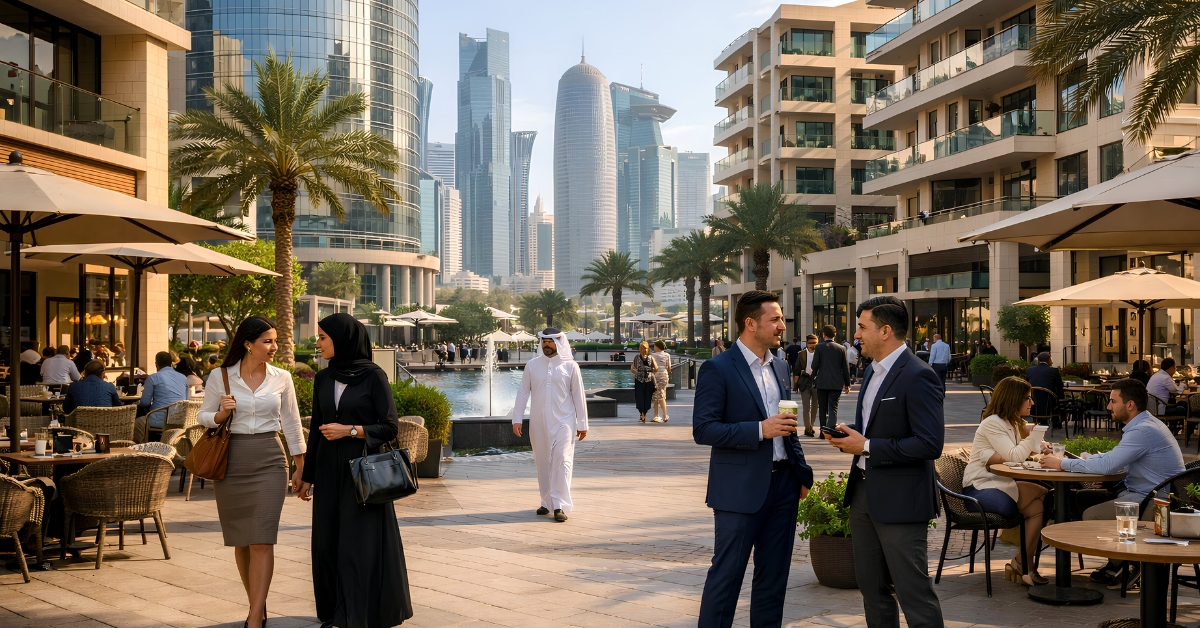
A major factor driving international firm interest is Qatar’s diverse and skilled workforce. Expatriates make up a significant portion of the labor market, bringing expertise across engineering, finance, construction, education, and healthcare.
Education City and international universities operating in Qatar contribute to the development of local talent, while flexible visa and employment frameworks enable firms to attract global professionals.
This workforce diversity increases demand for nearby residential and mixed-use developments, particularly in areas close to business districts such as West Bay, Lusail Marina, and Msheireb.
Commercial Real Estate Readiness
Qatar’s commercial property market is structured to support rapid business entry and scalable growth. International firms typically assess:
- Availability of Grade A office buildings
- Proximity to transport links
- Regulatory clarity for leasing and ownership
- Long-term occupancy cost stability
Business hubs like West Bay and Lusail offer modern office towers, serviced offices, and integrated commercial spaces suitable for multinational operations. FGREALTY works closely with corporate clients to identify properties aligned with headcount growth, compliance requirements, and budget planning.
How Qatar Compares Regionally
Compared with other regional hubs, Qatar offers a lower volatility environment and a more centralized planning framework. This results in fewer regulatory shifts and more consistent infrastructure delivery timelines, which global firms value when committing capital and personnel.
The World Economic Forum has highlighted Qatar’s infrastructure quality and institutional effectiveness as competitive advantages within the Gulf region, particularly for firms seeking long-term regional headquarters.
You can also check out our article that compares Qatar with other GCC real estate.
How FGREALTY Supports International Firms
FGREALTY assists global companies at the awareness and entry stage by providing market intelligence and tailored commercial real estate solutions. Our services include:
- Location analysis based on workforce access and connectivity
- Commercial leasing advisory and negotiation support
- Expansion planning for growing teams
- Compliance-aware property selection
Whether your firm is exploring Doha, Lusail, or emerging business districts, FGREALTY agents help align real estate decisions with operational goals.
FAQs
Q: Why do international companies choose Qatar for regional offices?
A: Qatar offers political stability, advanced infrastructure, and access to a global workforce, supported by long-term national planning.
Q: Is Qatar’s business environment stable for long-term investment?
A: Yes. International institutions consistently cite Qatar’s fiscal strength, governance continuity, and infrastructure quality as key strengths.
Q: Which areas are best for corporate offices in Qatar?
A: West Bay, Lusail Marina, and Msheireb are among the most established business districts for international firms.
Q: Does Qatar support foreign workforce mobility?
A: Yes. Workforce policies and visa frameworks are designed to attract skilled professionals across sectors.