The Future of Smart Buildings in Qatar Real Estate
Key Takeaways
- Smart buildings in Qatar are moving beyond basic automation toward connected building management and data-driven operations.
- Lusail was planned with smart metering, smart grids, intelligent traffic management, and building automation in mind.
- Qatar’s TASMU program has specifically identified smart-building applications for residential and commercial development.
- Smart HVAC management can provide real-time visibility into building utility consumption and support predictive maintenance.
- Qatar’s environmental strategy targets a 25% reduction in greenhouse gas emissions by 2030 against a business-as-usual baseline.
- The strongest investment case is not simply about having more technology; it is about having technology that improves operating efficiency, reliability, and building usability.
- Buyers should assess the actual systems installed, their integration and ongoing maintenance rather than relying on the label “smart building.”
Introduction
The future of smart buildings in Qatar will center on connected systems that monitor, automate, and optimize how buildings operate. For property buyers and investors, this means looking beyond smart locks or mobile-controlled lighting. The more important questions are whether a building can manage cooling, energy, water, security, access, and other systems efficiently, and whether its digital infrastructure can support future upgrades.
That distinction matters in Qatar’s climate and increasingly technology-focused urban developments. A smart building can affect more than convenience: its systems can influence operating costs, maintenance, resource consumption, and the overall quality of a residential or commercial asset.
Why Are Smart Buildings Becoming More Important in Qatar?
Qatar’s smart-building direction is closely linked to its wider digital and sustainability strategies. TASMU, the country’s Smart Qatar program, identifies smart buildings as a specific technology opportunity for both residential and commercial development, with applications including real-time utility monitoring and predictive maintenance.
Qatar’s environmental policies also place greater emphasis on efficient resource use. The national climate strategy targets a 25% reduction in greenhouse-gas emissions by 2030 compared with a business-as-usual baseline, while national development objectives include adopting cutting-edge environmental technologies.
For property investors, the implication is straightforward: technology should increasingly be evaluated as part of a building’s operating model, not merely as an amenity.
What Technologies Will Define Qatar’s Smart Buildings?
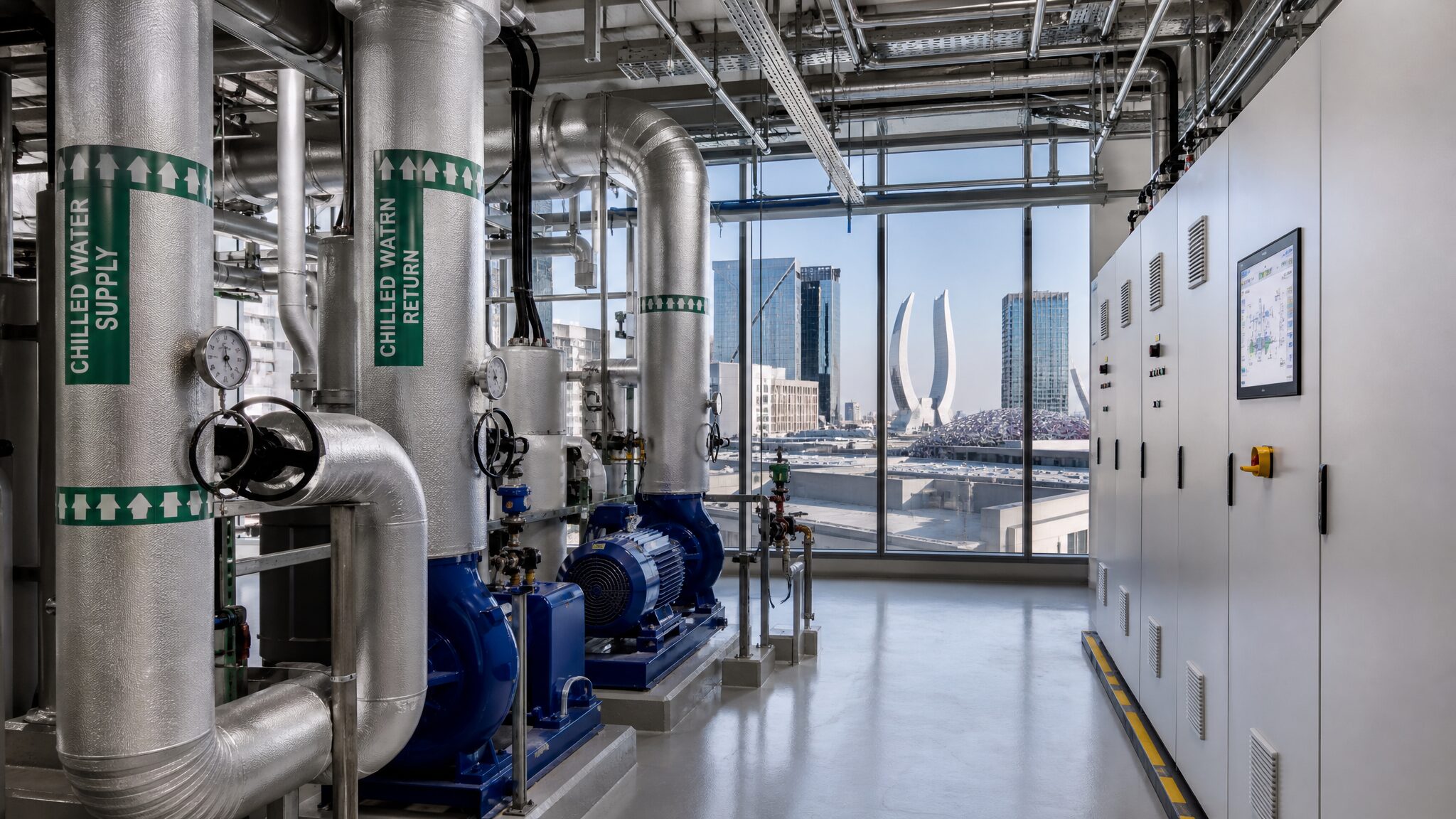
The most valuable systems will be those that connect different building functions and generate useful operational data. Qatar’s own smart-building initiatives already identify HVAC monitoring, real-time utility visibility, and predictive maintenance as practical applications.
Building Management Systems
A Building Management System (BMS) can coordinate systems such as:
- Air conditioning and HVAC
- Lighting
- Electricity and water monitoring
- Access control
- Security systems
- Elevators and other building equipment
- Fire and safety systems
Lusail’s smart-city guidelines specifically identify systems including CCTV, access-card readers, energy meters, district cooling, elevators, lighting, air-conditioning controls and fire controls within its smart-service architecture.
Smart Energy and Cooling
Cooling deserves particular attention when evaluating property in Qatar. Smart controls can monitor operating conditions and consumption while helping facilities teams identify inefficiencies and maintenance requirements.
Lusail’s master plan incorporates district cooling alongside smart metering and smart-grid infrastructure, demonstrating how building-level technology can connect with wider urban systems.
Why Does Lusail Stand Out in Qatar’s Smart-Building Landscape?
Lusail provides one of Qatar’s clearest examples of smart-city infrastructure being integrated into urban planning rather than added as an afterthought. Its master plan incorporates city-wide ICT infrastructure, smart metering, smart grids, intelligent traffic management and infrastructure designed to support automated homes and offices.
The city also has a centralized Lusail Command & Control Centre, which supports monitoring and management of smart services and associated data infrastructure. Its ICT backbone includes fiber-optic networks and public Wi-Fi.
For investors comparing buildings, this distinction is useful. A standalone “smart apartment” and a property connected to a broader smart-city ecosystem are not necessarily the same proposition.
What Does Smart Technology Mean for Property Investors?
Smart technology can strengthen an asset when it produces measurable operational benefits. However, investors should avoid paying a premium simply because a developer markets a property as “smart.”
A more useful evaluation focuses on function, integration, and maintenance.
What Investors Should Assess
Before buying, ask:
- Which smart systems are actually installed?
- Is there a centralized BMS?
- Can HVAC and utility consumption be monitored?
- Are meters individually or centrally monitored?
- Does access control integrate with security systems?
- Is the building connected to reliable fiber infrastructure?
- Who maintains the smart systems?
- What happens if individual components become obsolete?
- Are service and maintenance costs clearly documented?
This approach is particularly important for commercial property. A sophisticated office building may require stronger digital infrastructure, access controls, and building-management capabilities than a standard residential unit.
Does Smart Technology Increase Property Value?
Smart technology can support the long-term competitiveness of a property, but there is no basis for assuming that every smart feature automatically creates a specific percentage increase in property value or rental returns.
A stronger investment case comes from useful technology combined with location, building quality, demand, and efficient operations. Aqarat has itself highlighted innovation, smart cities, digital transformation and access to accurate information as important elements in the development of Qatar’s real estate ecosystem.
From a brokerage perspective, buyers should therefore compare the complete property proposition rather than treating smart features as a standalone selling point.
What Is the Future of Smart Buildings in Qatar?
The next phase will likely involve greater integration between buildings, infrastructure and data. Qatar’s Smart Qatar platform is designed around IoT, data analytics, machine learning and AI, while Aqarat’s strategic direction includes digital platforms, data analytics, interactive investment mapping and AI-supported solutions for the real estate sector.
This creates several areas worth watching:
- AI-assisted building operations
- Predictive equipment maintenance
- Automated energy management
- Integrated security and access
- Smart parking and transportation
- Real-time building performance monitoring
- Greater connectivity between buildings and city infrastructure
The important shift is from automation to optimization: buildings will increasingly use data to determine how systems should operate rather than simply allowing occupants to control them manually.
What Should Buyers Check Before Choosing a Smart Property?
A smart-building checklist should include both technology and conventional property fundamentals. Technology cannot compensate for poor location, weak management, or unsuitable layouts.
Before committing, check:
- Building management and automation systems
- Cooling and HVAC controls
- Utility monitoring
- Internet and fiber connectivity
- Security and access technology
- Maintenance arrangements
- Developer specifications
- Service-charge implications
- Compatibility with future technology upgrades
- Location and surrounding infrastructure
For buyers comparing properties in Lusail, The Pearl, Msheireb and other technology-focused communities, FGREALTY can help separate genuinely useful specifications from marketing language.
How FGREALTY Can Help
FGREALTY helps buyers assess Qatar properties according to the factors that matter to their intended use, whether that means a residence, investment property, office or commercial asset.
Our approach combines verified listings, local area knowledge, property comparisons and practical investment guidance. For technology-focused developments, that means looking at the building’s actual features alongside location, property type, positioning and suitability for the buyer’s objectives.
For international buyers and relocating professionals, FGREALTY agents can also support the wider property search and buying process, helping narrow options before viewings and due diligence.
FAQs
Q: Are smart buildings common in Qatar?
A: Smart-building technology is already incorporated into major developments and national smart-city initiatives. Lusail is a prominent example, with smart infrastructure and buildings designed to support automation and building-management systems.
Q: What is a BMS in a smart building?
A: A BMS is a system used to monitor and manage building functions such as HVAC, lighting, energy systems and other equipment. In Qatar’s smart-building framework, BMS forms part of a broader connected infrastructure rather than operating as an isolated feature.
Q: Can older buildings become smart buildings?
A: Yes, individual systems can be upgraded or retrofitted, although the feasibility depends on the building’s existing infrastructure. Qatar’s planning framework has also identified improving energy and water efficiency in retrofitted developments as a strategic objective.
Q: Does smart technology reduce maintenance?
A: It can help maintenance teams identify abnormal operating conditions and support predictive maintenance. Qatar’s TASMU smart-building initiative specifically identifies predictive maintenance as one of the potential benefits of real-time building data.
Q: Why does fiber connectivity matter in a smart property?
A: Connected building systems depend on reliable digital infrastructure for communication and data exchange. Lusail’s smart-city model incorporates fiber-optic infrastructure as part of the wider ICT backbone supporting residential, commercial, and civic services.