Why Transit Oriented Development Matters for Property Investors in Qatar
Key Takeaways
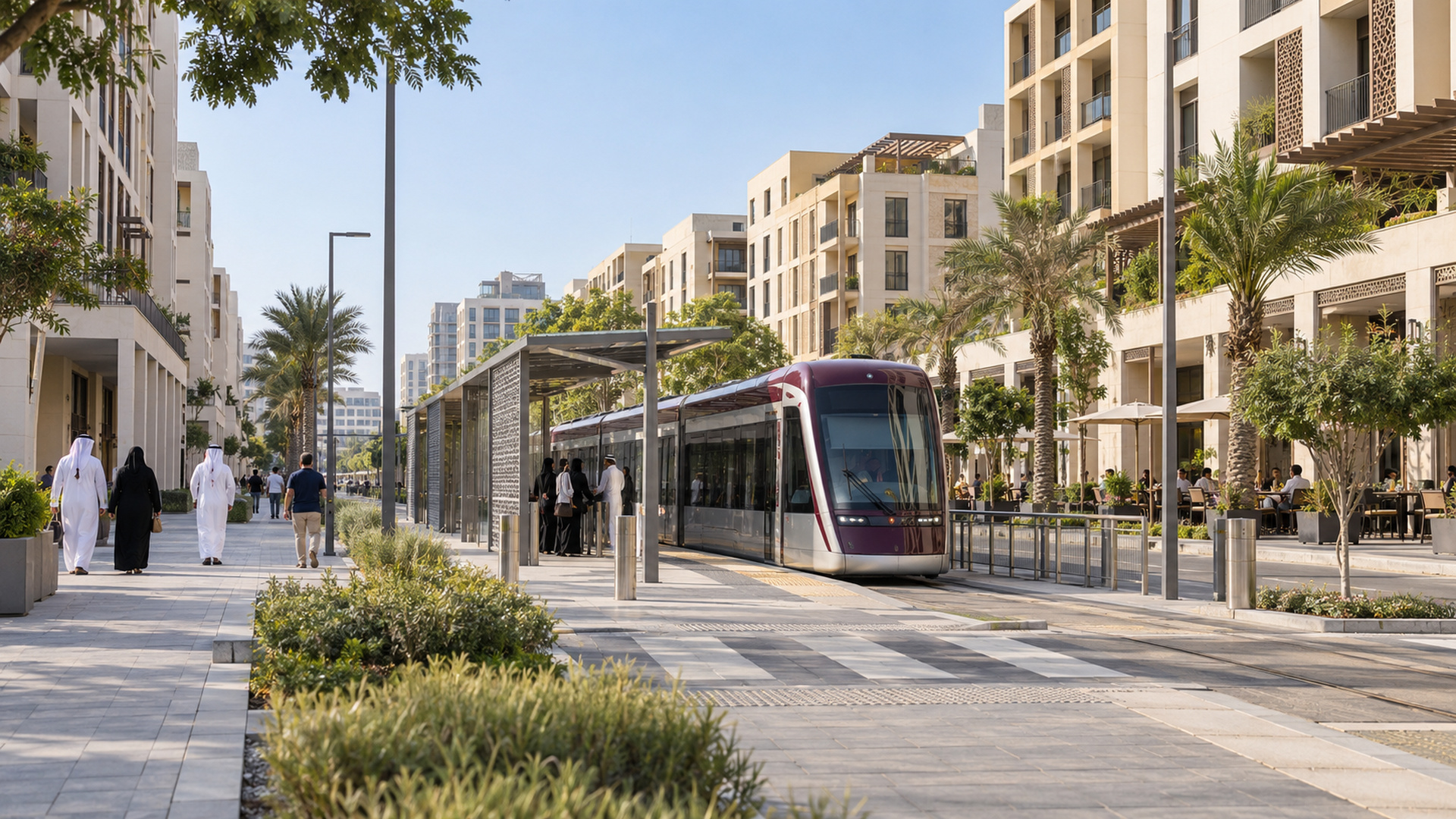
- Transit-oriented development, or TOD, combines public transport with housing, retail, offices, and community facilities.
- Qatar’s national planning framework specifically promotes higher-density, mixed-use development around public transport nodes.
- Qatar has designated 28 urban centers, including Lusail, West Bay, The Pearl, and several town and district centers.
- Lusail’s master plan includes 38 LRT stations across 38 km of rail and 67 km of planned cycle and pedestrian routes.
- TOD can improve accessibility and tenant appeal, but being close to a station does not automatically make a property a better investment.
- Investors should assess walking access, surrounding services, property supply, service charges, tenant demand, and actual transaction evidence.
- The strongest TOD opportunities combine transport access with employment, retail, residential density, and everyday services.
Why Does Transit-oriented Development Matter to Property Investors in Qatar?
Transit-oriented development matters because it can concentrate homes, workplaces, retail, and public services around accessible transport connections. That can make surrounding properties more convenient for residents and businesses while supporting more efficient use of infrastructure. Qatar’s own planning framework identifies TOD as a tool for reducing travel distances, improving accessibility, and optimizing returns on infrastructure and real estate investment.
For an investor, the important point is that a transport station is not the investment thesis by itself. The stronger question is whether the station connects people to places they actually need to reach.
That means looking at:
- Employment centers
- Schools and universities
- Retail and dining
- Healthcare
- Residential communities
- Offices and commercial districts
- Roads and other transport connections
A property that sits near a station but lacks useful destinations around it may have less practical value than a property within a genuinely mixed-use, connected community.
How is Qatar Planning for Transit-oriented Development?
Qatar has incorporated transit-oriented development directly into its national spatial planning framework rather than treating it only as a transport policy. The Qatar National Development Framework calls for an integrated public transport network and encourages transit-oriented town centers along strategic transport routes.
The country’s Centre Plans take this further. Qatar has designated 28 urban centers, consisting of 3 Capital City Centres, 3 Metropolitan Centres, 8 Town Centres, and 14 District Centres. The framework includes Lusail and The Pearl among these designated centers.
The planning model emphasizes:
- Mixed-use development
- Pedestrian orientation
- Ground-floor activity
- Higher density around transit
- Accessible community facilities
- More efficient infrastructure use
This matters to investors because these are the same characteristics that can make a location useful beyond a single building.
What Does TOD Look Like in Lusail?
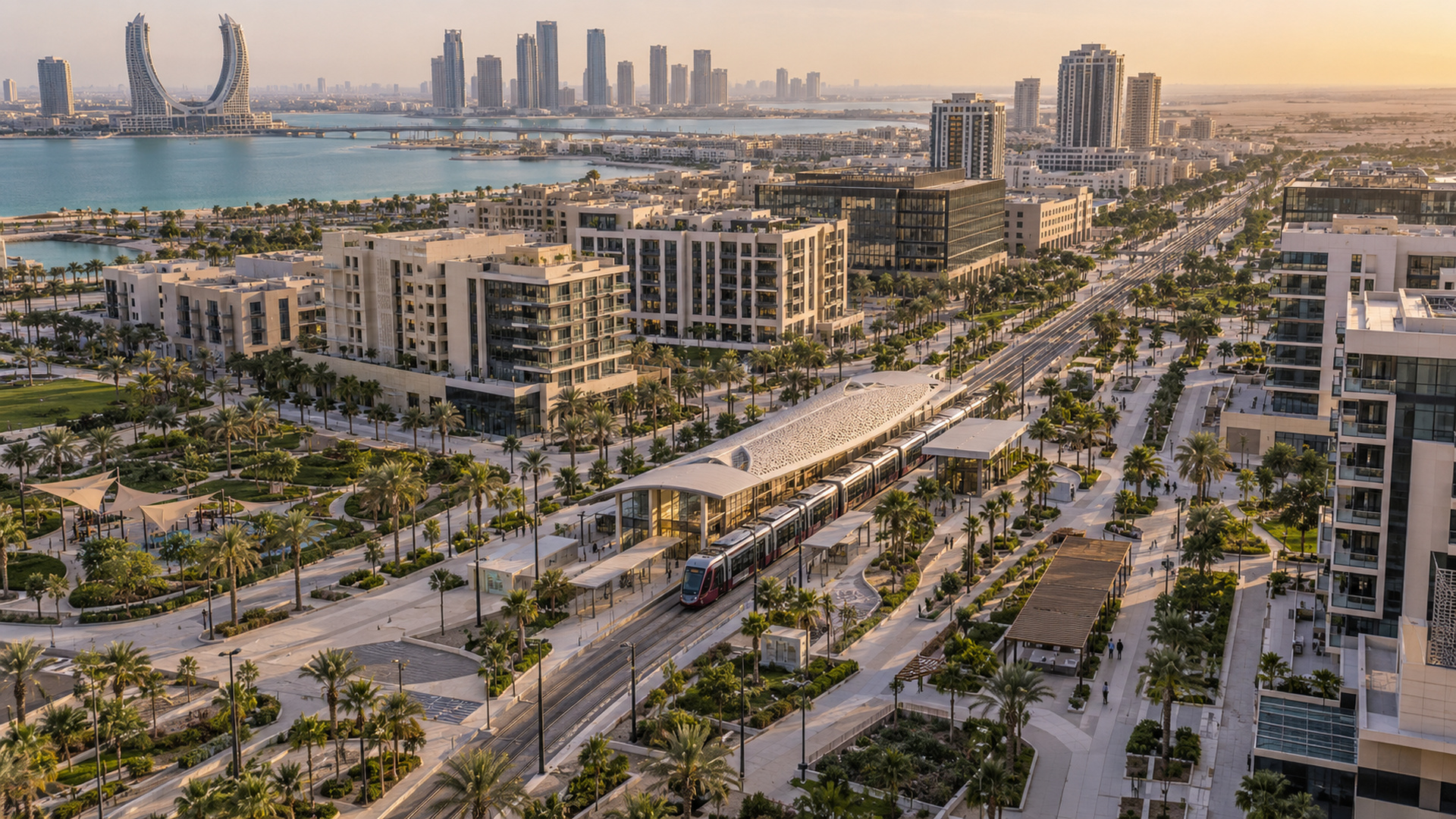
Lusail provides one of Qatar’s clearest examples of transport being planned alongside residential, commercial, and retail development. Its master plan includes 38 LRT stations across 38 km of rail, connecting the city’s 19 districts. It also includes 67 km of cycle and pedestrian routes designed to connect the city.
The plan also incorporates park-and-ride facilities, water transport, and a complementary bus network connecting residential, commercial, and retail areas to the wider public transportation system.
For a property investor, this creates several potential advantages.
More Than One Way to Reach the Property
A connected location can appeal to people who drive, use public transport, or prefer shorter local trips.
A Wider Tenant Pool
Properties near employment, retail, dining, and transportation can serve different tenant profiles rather than relying on one narrow demand segment.
Stronger Community Utility
A neighborhood becomes more useful when residents can reach everyday services without making every trip dependent on a car.
This does not mean every Lusail property has the same investment potential. Building-level location still matters.
Does Being Near a Metro Station Guarantee Higher Property Returns?
No. Proximity to public transport can be an advantage, but it does not guarantee price appreciation, rental growth, or resale liquidity.
An investor should distinguish between station proximity and useful connectivity.
A property may be technically close to a station but still have:
- Poor pedestrian access
- Major roads between the building and station
- Limited retail nearby
- Weak employment connectivity
- High service charges
- Excess competing inventory
- Unattractive building quality
Qatar’s Centre Plans specifically emphasize pedestrian orientation and mixed-use development rather than transport access alone. The planning framework identifies benefits including reduced journey times, improved walkability, more efficient infrastructure use, and optimized returns on infrastructure and real estate investment.
That distinction is important when evaluating listings.
Which Qatar Locations Should Investors Examine for TOD Characteristics?
Investors should start with areas where transport is integrated with broader urban development rather than simply searching for properties with a nearby station.
Lusail
Lusail stands out because its master plan integrates LRT, pedestrian routes, water transport, residential districts, commercial areas, and retail. Its designation as a Metropolitan Centre under Qatar’s Centre Plans also reflects its role within the country’s planned urban structure.
The Pearl
The Pearl is identified as a District Centre within Qatar’s Centre Plans. Its established residential, retail, dining, and waterfront environment makes it useful for investors assessing how transport access works alongside a mature mixed-use destination.
West Bay
West Bay is designated as a Capital City Centre. Its role as a major business and commercial destination makes connectivity particularly relevant when assessing residential properties aimed at professionals and corporate tenants.
The key is not to rank these areas simply by proximity to transit. Their investment profiles differ because their tenant bases, property types, supply, and surrounding commercial activity differ.
What Does Recent Qatar Property Activity Tell Investors?
Recent transaction data shows that active property markets extend across several municipalities that are connected to Qatar’s wider urban and transport network.
In July 2026, Qatar recorded QAR 1.859 billion across 485 real estate transactions. Doha accounted for QAR 763.8 million, Al Rayyan QAR 461.4 million, and Al Daayen QAR 230.3 million. Al Daayen represented 18% of the month’s registered transaction count.
The figures do not prove that TOD caused transaction activity. They do, however, show why investors should examine location-level transaction evidence instead of assuming that a transport project automatically creates investment demand.
The Ministry of Justice also reported 114 residential unit transactions worth QAR 197.8 million in July 2026.
For investors, the better approach is to combine market activity with property-level research.
How Should Investors Evaluate a TOD Property?
The most useful test is to score the property on connectivity, convenience, demand, and competition.
Check the Actual Walking Route
Do not rely on a map pin alone. Examine the route between the building and station, including crossings, roads, entrances, shade, and pedestrian infrastructure.
Identify What the Transport Connects to
A station becomes more valuable when it provides practical access to employment, education, retail, hospitality, and other major destinations.
Measure Competing Supply
If a transit-connected district is adding thousands of similar units, improved accessibility may also bring more competition.
Compare:
- Available units
- New developments
- Rental listings
- Unit sizes
- Service charges
- Building amenities
- Asking prices
- Recent transactions
Match Transport Access to the Target Tenant
A family, corporate professional, student, tourist-oriented tenant, and commercial occupier may value connectivity differently.
FGREALTY’s role is particularly useful here because the question is not simply “Which property is closest to transit?”
It is “Which property benefits from the right type of connectivity for its intended occupant?”
Is TOD More Important for Residential or Commercial Property?
Both can benefit, but the investment logic differs.
For residential property, assess commuting convenience, nearby services, walkability, schools, retail, and tenant demographics.
For commercial property, consider employee access, customer movement, visibility, parking, surrounding business activity, and connections to major roads and commercial districts.
Qatar’s Centre Plans explicitly allow mixed-use zones combining retail, office, and residential uses, reinforcing the importance of looking at the wider land-use pattern rather than analyzing transport infrastructure in isolation.
How FGREALTY Can Help
FGREALTY can help investors compare properties based on location, connectivity, property type, tenant profile, competing supply, and investment objectives rather than relying on a single feature such as proximity to a metro station.
For international buyers and expats, that can include identifying suitable communities, verified listings, relocation considerations, viewing coordination, and guidance through the purchase process.
For investors, FGREALTY agents can help compare residential opportunities in communities such as Lusail, The Pearl, and West Bay while considering the factors that actually influence demand.
Commercial buyers can also assess access to transport, major roads, business districts, employees, customers, and surrounding commercial activity.
The objective is straightforward: understand what the infrastructure does for the property before paying a premium for it.
FAQs
Q: What is the difference between TOD and a property near a metro station?
A: TOD is a broader development model that combines transit with higher-density housing, mixed uses, pedestrian access, and community facilities. A property can sit near a station without being part of a genuinely transit-oriented neighborhood.
Q: Does TOD reduce reliance on cars in Qatar?
A: That is one of its intended planning outcomes. Qatar’s National Development Framework calls for public transport that can shift some travel away from private vehicles, while its Centre Plans promote walking, cycling, and public transport alongside mixed-use development.
Q: Why is mixed-use development important for TOD investors?
A: Mixed-use development places different activities closer together, creating reasons for people to live, work, shop, and access services within the same area. This can make transport infrastructure more useful because residents have more destinations within the connected district.
Q: Can TOD affect commercial property demand?
A: It can improve accessibility for employees, customers, and visitors, but the impact depends heavily on the business type. Retail, hospitality, offices, and service businesses should each be evaluated against their specific access requirements.
Q: Is Lusail the only TOD-style investment area in Qatar?
A: No. Qatar’s Centre Plans identify 28 urban centers, including West Bay, Doha Downtown, Airport City, Lusail, The Pearl, and other town and district centers. Their development roles and transport characteristics differ, so investors should assess each location individually.
Q: Should investors pay more for a property because it is near transit?
A: Not automatically. The transport advantage should be compared against the property’s price, service charges, competing supply, rental demand, building quality, and other location factors before accepting a premium.